
Almost every organisation has a disaster recovery plan. Far fewer have ever run it.
The document exists because an auditor, an insurer or a customer asked for one. It lists the systems, gives each a recovery time, names a supplier and was approved at a meeting. Then it was filed — quite often on one of the systems it explains how to restore.
Whether that plan works is not known. It is assumed. The evidence of the last few years is that the assumption is expensive.
What the numbers say
Uptime Institute's 2025 outage analysis found that 54% of operators put the cost of their most recent significant outage above USD 100,000. One in five put it above USD 1 million.
Ransomware is the harder test, because it arrives on purpose. Veeam surveyed 1,300 organisations for its 2025 ransomware report, and 900 of them had been hit in the previous 12 months. Of those, 10% recovered more than 90% of their data. More than half — 57% — recovered less than half of it. Few of those organisations would have said, the week before, that they had no backups and no plan.
Then there is July 2024, when one faulty update from one security vendor stopped 8.5 million Windows devices in a morning. Every affected organisation had the same fault and was offered the same fix. Some were working again within hours. Delta Air Lines cancelled around 7,000 flights and has put its loss above USD 500 million, a figure and a liability the vendor disputes.
Same fault, same fix, very different bills. Whatever a court decides about that case, the spread tells you recovery is decided by something other than the fault.
A backup is not a recovery
Most organisations measure the wrong half. The backup job is checked every night and reported green. The restore is checked rarely, usually one system at a time, on a quiet afternoon.
That tests the backup tool. A real incident takes out several things at once, including the things the restore depends on: the identity service you log in with, the network, the password vault, the documentation. The runbook assumes all of those are standing.
A backup answers "do we hold a copy?". Recovery answers a different question: how long until the business is working again, and in what order do things come back. Only the second one matters to anyone outside IT.
The plan is written by system. The business fails by process.
Here is where recovery becomes a governance problem and stops being a technical one.
A recovery plan is a list of systems. A business is not. An order touches the website, the finance platform, the warehouse, a payment provider and — in more companies than would admit it — a spreadsheet that one named person maintains.
Restore four of those five and the order process is not 80% recovered. It is stopped.
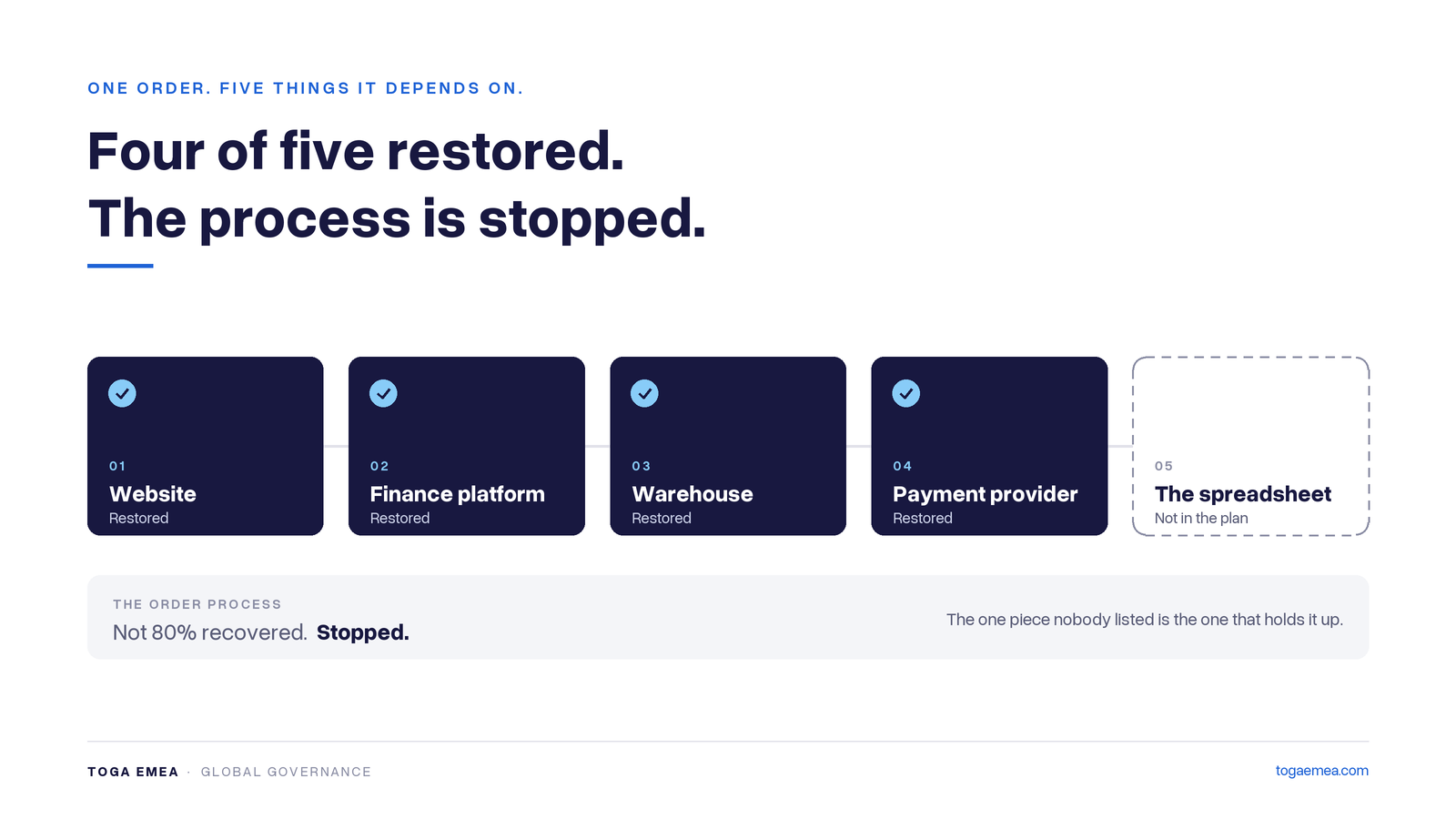
The spreadsheet and the person are not in the plan, because nobody thinks of them as systems. I wrote in an earlier piece that technology estates fail in the joins between departments, and that nobody owns the joins. Recovery fails in exactly the same place, for exactly the same reason.
So how efficient is the average strategy?
Not very, and not because too little is spent.
Every plan carries two numbers per system: how quickly it must be back, and how much recent data the business can afford to lose. In most plans I have read, IT set both — from what the technology could do, or from what the template suggested. The people who own the revenue were never asked how long they could go without invoicing, or how much of a day's orders they could re-key by hand.
The result is money in the wrong places. One system has expensive replication and a four-hour target, and the business would shrug if it were down for a week. Another has a nightly copy and no tested restore, and it stops revenue within the hour. The organisation is over-insured and under-insured at once, and the total looks reasonable on a budget line.
That is the honest assessment of most recovery strategies: real effort, real spend, pointed at systems instead of at the business.
Who declares a disaster?
The second gap is decision rights, and it only shows on the day.
Who is allowed to say "this is a disaster" and start the plan? Who can authorise emergency spend at two in the morning? Who decides to fail over to the standby, knowing that it means losing the last hour of transactions? Who tells customers, the insurer and the regulator, and inside what deadline? What does the supplier's contract oblige them to do, and how fast?
If those answers are not written down, they are made up under pressure by whoever happens to be awake.
Regulators have reached the same conclusion. The EU's Digital Operational Resilience Act has applied to financial firms since 17 January 2025 and requires continuity and recovery plans to be tested at least once a year. I expect that standard to travel — into other sectors, into customer contracts and into insurance renewals.
How Toga makes it better
Global Governance is Toga's assessment and operating model practice. We start from the business, not from the backup product, and we look at recovery through the same five lenses we use everywhere else.
What the business does. Which processes earn revenue or carry an obligation, and how long each can stop. The business sets those tolerances. We make sure the question is asked of the right people.
What the technology is. One inventory, with an owner against every line and its dependencies drawn — including what the restore itself needs in order to run.
Where the two meet. The spreadsheets, shared mailboxes and individuals that work passes through. They go in the plan with everything else.
How decisions are made. Written decision rights for an incident: who declares, who spends, who fails over, who speaks. It fits on a page.
Where you are exposed. The single supplier, the single region, the single administrator account, the one person who knows.
What comes out is a recovery order the business has agreed, a target with a cost against each tier, a short list of gaps to close, and a rehearsal — run with the people who would be in the room on the day. After that we keep it true: a standing review, and a re-test after every significant change.
Often the answer is less. Every system retired is one fewer to recover. Every target relaxed where the business says a week is acceptable frees budget for the place where an hour is too long.
A test you can run this week.
Pick one system the business could not trade without. Before anything else, ask its commercial owner two questions: how long do you think it would take to restore, and how long could you tolerate? Then have it restored — all of it, into an isolated environment so the test cannot harm the live system, by the person who would do it on the day, with a stopwatch running.
You now have three numbers: the documented target, the business's tolerance and the measured time. If they are not close to each other, you have found your gap for the price of an afternoon.
Speak with Toga. tega@togaemea.com · +971 50 154 8451
Oghenetega Gharoro-Akpojotor is the founder of Toga EMEA, a boutique technology management consultancy working across Europe, the Middle East, Africa and APAC. Global Governance is Toga's assessment and operating model practice.